A recent news report from the Associated Press has shed light on the lack of clinical studies and scientific research on the effectiveness of flossing. Please remember when reading this AP news article that "inadequately researched" certainly does not equate to flossing "been proven useless or ineffective." This most certainly should not lead us to the conclusion that flossing has no effect on dental health. Even the reporter himself admits he still uses floss daily to remove food from between his teeth.
The question can be asked, "How many scientific studies have there been saying getting shot with a bullet is bad for your health?" None or few. However, common sense as well as real-life examples, talking to doctors, surgeons, or coroners, would lead you to the sensible conclusion that getting shot with a bullet is bad for your health. Similarly, neglecting proper dental care between your teeth daily whether it is with floss, or other dental aids is certainly bad for your oral health.
Bacterial plaque has a direct relationship in the development of caries and periodontal disease. Excellent daily oral hygiene is necessary to remove dental plaque daily to prevent oral disease to remove plaque around and between the teeth, as well as a review of diet, risk factors, and medical history.
Most patients brush for at least a short period of time, but it is important to use interdental (between the teeth) devices in addition to toothbrushes. Toothbrushes are relatively ineffective between the teeth, and periodontal disease typically begins between the teeth. Preference, availability, interdental anatomy, and dexterity (patient's physical ability) all play roles in the selection of an interdental cleaning device. Sometimes, more than one aid is required to effectively remove plaque. This is especially true for our periodontal patients. Interdental cleaning is so important for the health of your gums and should be done every day!
Since our stance is flossing and/or other interdental care is effective and necessary to prevent both cavities and prevent and control periodontal disease, let's compare our two favorite interdental aids.
DENTAL FLOSS
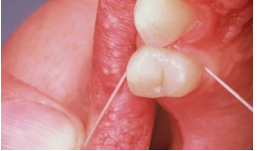
Floss is able to reach into narrow spaces between the teeth where use of an interdental brush may be very difficult and will also remove plaque where two teeth have contact.
Flossing is certainly technique sensitive. If floss is used too vigorously, gum tissue can be traumatized. Typically, dental floss should be wrapped around the 2 middle fingers and stretched to a 12 to 18 inch length. Gently move back and forth in the area where the teeth contact each other, wrapping your floss it in a “C” shape around the side of the tooth. Once the floss is through this contact area it is gently moved under the tissue just until resistance is met. It is important not to “jam” the floss under the tissue, as this pulls on the periodontal ligament and can cause damage to the tissue and result in very sore gum tissue. At this point a cleaning stroke moves the floss away from the gum tissue toward the contact spot. Continue with this 6-8 times until a squeak can be heard and the tooth surface is clean. Then move the floss to the adjacent tooth and do the same.
Possible limitations of floss: Back teeth (molars and premolars) often have a more complex anatomy between teeth due to root concavities. A root concavity is a linear developmental depression in the root surface. In health, root concavities are covered in alveolar bone and actually help secure the tooth in the bone. Flossing may not access these difficult to clean and plaque retentive areas. So for many periodontal patients, flossing as well as the use of an interproximal brush is necessary.
(anatomy (with root concavity) of a premolar)
INTERDENTAL BRUSHES
Interdental brushes (proxabrushes), floss and mechanical devices, are available to remove plaque between the teeth. Clinical studies have shown that manual interdental brushes are particularly effective at reducing plaque and gingivitis. Selecting the sizes and types of interdental cleaning devices that are best for you should include an assessment of the space between your teeth, contact points, areas that retain food, gum shape and position, and periodontal pocketing.
Interdental brushes, or proxabrushes come in wider or thinner sizes Go-Betweens®
(Sunstar Butler), to accommodate the various dimensions
of the interdental spaces. Interdental brushes are available with both coated and uncoated wire, and some include antibacterial agents (chlorhexidine) on the bristles. There are also ultrathin, rubbery versions of interdental brushes called Softpicks and Advanced Softpicks® (Sunstar Butler). Our patients who have dexterity issues
often find interdental brushes or Softpicks easier to use than floss.
There are also mechanical (or vibrating interdental brushes), but they do not seem to be as effective as floss or the manual interdental brushes. A study of a mechanical interdental device
(Interclean) in a German population revealed more plaque than with manual interdental
brushes. 5 percent of
interdental plaque remained following patient use of manual
interdental brushes in this study. In other studies, the same device
was compared to the use of dental floss, and the device and
manual dental floss were found to be equally effective in
reducing plaque. Based upon the results of these clinical studies, manual interdental brushes are superior
and floss is equally effective in reducing plaque.
The article by the AP about flossing has brought dentistry and oral hygiene, particularly flossing, into the news and into people's minds. For that, we are thankful. Even people who admittedly do not floss, are coming to flossing's defense. And it certainly opens up some open, some lighthearted and some not-so lighthearted discussion on the topic (many dental hygienists, assistants and dental practicioners are NOT happy with this article or the confusion it could cause!)
Ultimately, the goal of oral good hygiene and good dental care is to prevent, arrest, and control periodontal disease and caries. One's ability to remove plaque from all areas, including interproximal areas, is an essential part of every patient’s selfcare program. Your dentist, dental hygienist, and periodontist can work with you as to which oral hygiene aids are going to improve your oral health by examining the effectiveness of your daily plaque removal routine (measuring your plaque levels and the condition of your gum tissues), as well as selecting and demonstrating the best oral hygiene aids for your lifestyle, ability, health, tooth anatomy, your risk for cavities and your periodontal condition.
Britten Periodontics & Implant Dentistry is a periodontal practice offering patients personalized dental care in implant dentistry in Clearwater, Florida. Dr. Todd Britten received his Bachelor of Science & Doctorate of Dental Surgery from University of Florida, a Master’s Degree and Certificate in Periodontology and Implant Dentistry; and completed extensive training at the Institute of Advanced Laser Dentistry. He is one of the only board-certified periodontists in Pinellas County. He is a member of the American Academy of Periodontology, American Dental Association, Florida Association of Periodontists, Upper Pinellas County Dental Association, Hillsborough County Dental Association, Hillsborough County Dental Research Association and Florida West Coast Dental Association.


