Showing posts with label Dental. Show all posts

Thursday, November 7, 2019

5th annual Day of Care for Veterans.


On November 1st, Dr. Todd M. Britten and the team at Britten Periodontics & Implant Dentistry held their 5th annual Day of Care for Veterans.  Dr. Britten and his team are aware that dental coverage for veterans for major dental surgery can be very hard to attain, so they “hit the ground running” in 2015 trying to deliver periodontal care to as many veterans as they could. Dr. Britten says he owes the success of the event for the last 5 years to the help of local dentists, Clearwater Dental Associates (Dr. Nolan Allen, Dr. Matt Burton, Dr. Jim Hayslett and Dr. Keith Kiskaddon), Dr. Jeffrey Ellenberg, Dr. Ira Berger, Dr. Michael Podlusky and the local Clearwater Dental Clinic.
Dr. Britten provides advanced periodontal surgical treatment and dental implant care for veterans in his Clearwater, Florida based periodontal practice. He offers sedation options and high-tech treatment, which can be very helpful to veterans that suffer from PTSD.
For Britten and his team this event is something they look forward to all year long. They keep in touch with veterans from previous events and this year they were able to provide follow up exams, x-rays and periodontal maintenance procedures, which help prevent reinfection of the gums following treatment. "It is always great to see them again and the progress they have made in their oral health. It is touching to be a part of something that has changed someone's life in such a positive way," said one of Dr. Britten’s volunteers.
Dr. Britten explained that local restorative dentists and their teams have volunteered each year to help provide comprehensive dental care to our veterans. As a periodontist, Dr. Britten’s specialty is the surrounding structures of the teeth; roots, gum and bone; i.e., the foundation. The restorative specialists have done fillings, crowns, and even full sets of dentures for veterans at no cost each year. “Our practice alone has provided over $50,000 in periodontal procedures for patient,” says Ellen, a dental hygienist at Britten Periodontics who has helped to coordinate the event each year.
"I have always respected the sacrifices that our veterans and their whole families had to make to ensure our safety and freedom. The sacrifices are really innumerable,” said Dr. Britten.
Britten Periodontics & Implant Dentistry is a periodontal practice offering patients personalized dental care in implant dentistry in Clearwater, Florida. Dr. Todd Britten offers sedation dentistry. For more information, visit http://www.brittenperio.com
A video of last year's event: https://www.youtube.com/watch?v=S82xHdxBEnQ

Wednesday, October 17, 2018

More patients can reclaim their smiles and oral health with dental implants thanks to sinus augmentation


A sinus augmentation graft procedure makes it possible for many patients to have dental implants when years ago there was no other option besides wearing loose dentures.
An indirect sinus lift is less invasive than a direct sinus augmentation lift and is performed by preparing the bone for the dental implant as normal. Once the floor of the sinus has been reached, bone is gently packed in the preparation and pressed upward. This motion will tent the membrane of the sinus upward and create additional room for the full length of the implant. Care will be taken not to damage the sinus and this procedure will have no effect on sinus pressure or affect people that suffer from seasonal allergies.

Britten Periodontics & Implant Dentistry is a periodontal practice offering patients personalized dental care in implant dentistry in Clearwater, Florida. Dr. Todd Britten received his Bachelor of Science & Doctorate of Dental Surgery from University of Florida, a Master’s Degree and Certificate in Periodontology and Implant Dentistry; and completed extensive training at the Institute of Advanced Laser Dentistry. He is one of the only board-certified periodontists in Pinellas County. He is a member of the American Academy of Periodontology, American Dental Association, Florida Association of Periodontists, Upper Pinellas County Dental Association, Hillsborough County Dental Association, Hillsborough County Dental Research Association and Florida West Coast Dental Association.

To learn more about Dr. Britten and his dental services, call us (727) 586-2681. For more information about sinus augmentation from the American Academy of Periodontics visit https://www.perio.org/consumer/sinus-augmentation.

Indirect sinus lift Video:
https://youtu.be/hFwGzeMCiLI

Wednesday, May 2, 2018

Does Sugar Cause Cavities?


A diet high in sugar certainly promotes the formation of cavities, but sugar itself isn’t the only culprit behind tooth decay.
Cavities are formed when bacteria living in the mouth digest carbohydrates left on the teeth after you eat. This includes refined sugars found in cookies, candy or other treats, however they may also come from healthy foods like whole grains, vegetables and fruits.
When digesting carbohydrates, bacteria in your mouth produce an acid that combines with food debris and saliva and forms plaque.
It’s the plaque — not sugar — that directly leads to tooth decay. Plaque starts building up after every meal, and if it isn’t brushed away frequently, it can erode the hard, outer enamel of a tooth, resulting in tiny holes in the tooth’s surface. These holes mark the first stage of cavities and can do a lot of damage to a tooth if left untreated.
Eventually, acid and bacteria in plaque can eat through the other layers of your teeth, as well — from the softer layer of teeth under the enamel, known as dentin, to the third layer (the pulp), which contains your teeth’s blood vessels and nerves. Cavities affecting the pulp of a tooth, as well as the bone supporting the tooth, can cause severe toothaches, sensitivity, pain when eating and even abscesses in the mouth.
It is important to know that the kinds of foods and drinks you consume, and how you are consuming them is also important to oral health.
Sticky foods — like hard candy, breath mints, raisins and dry cereal — can get stuck in the grooves and crevices of your teeth, where they could cause decay. Fruit and yogurt, on the other hand, wash away easily with saliva and are, therefore, less likely to cause plaque buildup.
Quickly finishing a can of soda does less damage to your teeth than sipping on it throughout the day, because the acid created by mouth bacteria stays in the mouth around 20 minutes after eating or drinking. Every time you eat carbohydrates, sugary food, or take a sip of soda, you restart the plaque-production clock and increase your risk of developing cavities.
In addition to a high sugar content, soft drinks and sports drinks also contain phosphoric and citric acids that erode tooth enamel. Eating or drinking highly acidic foods — even healthy foods, like citrus fruits — can lead to tooth decay if oral hygiene is not properly maintained.
None of us can totally avoid eating all carbohydrates, sugars, or acidic foods all of the time but we can limit the amount and more importantly the frequency of consumption. And we can also work on effective and regular plaque control by using oral hygiene aids to remove the plaque colonies which are forming constantly on the teeth.
Dr. Britten recommends brushing at least twice a day with a power toothbrush for two minutes as well as cleaning between the teeth at least once a day using floss or other interdental aids. For more information on effective oral hygiene and plaque control visit our website atwww.brittenperio.com or call the office at 727-586-2681.#wednesdaywellness

Tuesday, May 1, 2018

Are you a candidate for implant dentures?

If you're tired of high maintenance and uncomfortable dentures, you might be able to have implants placed to support your denture. An implant-supported denture is used when a person doesn't have any teeth in the jaw, but has enough bone to support implants. An implant supported denture snaps into place on dental implants. This prevents the denture from slipping or coming loose in the mouth. It also removes the need for denture paste or adhesives. The implant supported denture can be removed at night for cleaning or, if you have a fixed implant supported denture placed, your dentures will act as permanent teeth.


There are two types of implant supported dentures, bar-retained dentures and ball-retained dentures. Both types of dentures require two or more dental implants to be placed and both will provide you with a beautiful, natural smile.

Bar-Retained Dentures

In the bar-retained type of denture, three or more implants are surgically placed in the gums. Attached to these implants is a metal bar that runs along the gum line. The denture then rests on the metal bar and is attached using clips or other types of attachments. This type of implant-supported denture holds the denture in place without the steel studs used in ball-retained dentures.

Ball-Retained Dentures

Ball-retained dentures, also called stud-attachment dentures, use a ball-and-socket design to attach the dentures to the implants surgically placed in the gums. Traditionally, the denture is fitted with sockets and the implants have a ball on top of them. The denture and implants snap together where the ball and sockets meet.

Many patients prefer implant-supported dentures to traditional dentures because they alleviates much of the discomfort and rubbing of traditional dentures. The denture is held in place far more securely and is less likely to come loose. Dr. Britten is a dental implant specialist who can evaluate to see if you are a candidate for implant-supported dentures. Call us today 727-586-2681 or visit www.brittenperio.com

Monday, November 6, 2017

Clearwater Periodontist Holds Third Annual Veteran's Day Event

Dr. Todd M. Britten and the team at Britten Periodontics & Implant Dentistry had an early start on Veteran's Day which is Friday, November 11th. They held their 3rd annual Free Dental Day for Veterans on Friday, November 3rd, 2017. Britten Periodontics once again had overwhelming offers to help from many dental professionals in the community willing to donate their time and resources to provide free dental care. Patients were directed to the event this year from The Homeless Emergency Project in Clearwater, as well as local V.A. Branches from Pinellas, Pasco and Hillsborough counties.
“Once again, we have had an incredible response from the community and were able to get skilled and compassione local restorative dentists involved.” For the third year in a row, Clearwater Dental Associates, Dr. Jim Hayslett and Dr. Keith Kiskadden and their staff are on board to help out with our event, seeing patients for fillings, crowns and even dentures. New to this year’s event, Dr. Michael Podlusky in Seminole, Florida, also reached out to Dr. Britten to also help, making upper and lower dentures at no-cost for one of the patients. "Many thanks to Dr. Britten for organizing the Veteran's Day Event and graciously offering me the opportunity to help treat a patient. So glad to help at least one of our honored Vets. One person can't do everything, but all of us working together surely can!" Said Dr. Mike Podlusky.   


Dr. Britten’s dental specialty, periodontics, often involves managing and treating advanced gum disease. A periodontist is often able to help a patient in danger of losing teeth or with active oral infection to turn their health around. “Having Clearwater Dental Associates involved again this year, and the gracious help of Dr. Mike Podlusky and his team enables us to provide more comprehensive care to our veterans. Being a periodontist, my specialty is really the surrounding structures of the teeth; roots, gum and bone. My job is to help with the foundation. Having the restorative specialists involved helps us to treat the whole mouth and really deliver comprehensive care to these veterans.” Dr. Britten sees most patients for a comprehensive evaluation, radiographs and treatment consult prior to the event in order to determine what services he as the gum specialist can provide in his office, and make appropriate referral for restorative care from local dentists who have volunteered to help with the event.
Britten says being able to offer two different forms of sedation to Veterans for this event in his Clearwater, FL practice has helped for patients who have PTSD, dental anxiety, or may require extensive surgical treatment.  Dr. Britten expressed his concern. “Most of the time, periodontal disease is not painful until it gets to be very advanced. Some of the veterans had been dealing with painful teeth for a long time.”
For Britten and his team this event is something they look forward to all year long. They keep in touch with veterans from previous events and this year they were able to provide follow up exams, x-rays and periodontal maintenance procedures, which help prevent reinfection of the gums following treatment. “This year we were able to invite Veterans from previous events to receive follow up maintenance care at this year’s event,” said one dental hygienist at Britten Periodontics who helped organize this year’s event. "It was great to see them again and the progress they have made in their oral health. It is touching to be a part of something that has changed someone's life in such a positive way."
One patient returning this year received treatment at the inaugural event was John Smith, who served in the US Navy in Vietnam from 1965-1969. Dr. Britten explained that he was honored to be able to help Mr. Smith and to continue in his care since the 2015 event. The VFW Post 2473 in Clearwater where Mr. Smith serves as canteen manager does much to help local veterans.
When asked what this event meant to him in 2015, Smith had stated, "I get to keep my teeth and I can't believe it's free." A patient new to this year's event, Yvette said, "This was the most amazing dental cleaning I have had in my whole life!"
Dr. Todd Britten explained how glad he is to be doing this the third year in a row and would like to do it annually for the entirety of his career. When asked why this is a cause so near and dear to his heart he stated that his grandfathers and uncles served in the military and giving back to veterans in need is a top priority for him. Dr. Britten said, “The entire staff at Britten Periodontics is so grateful to the men and women in the military that make so many sacrifices for our freedom.”

Britten Periodontics & Implant Dentistry is a periodontal practice offering patients personalized dental care in implant dentistry in Clearwater, Florida. Dr. Todd Britten received his Bachelor of Science & Doctorate of Dental Surgery from University of Florida, a Master’s Degree and Certificate in Periodontology and Implant Dentistry; and completed extensive training at the Institute of Advanced Laser Dentistry. He is one of the only board-certified periodontists in Pinellas County. He is a member of the American Academy of Periodontology, American Dental Association, Florida Association of Periodontists, Upper Pinellas County Dental Association, Hillsborough County Dental Association, Hillsborough County Dental Research Association and Florida West Coast Dental Association.

www.brittenperio.com


x

Monday, May 1, 2017

What is Gum Recession?

Clearwater FL Periodontist Dr. Todd Britten discusses Gum Recession

Gum recession is the process in which the gum tissue that which surrounds your teeth wears away, or pulls back, exposing the tooth's root. If left untreated, gum recession may ultimately result in tooth loss.

Most people don't notice their gums receding because it occurs very gradually. You may notice tooth sensitivity, or that your tooth looks longer than normal. Sometimes a notch can be felt near the gum line with your fingernail
Gum recession is often caused by periodontal disease. If untreated, gum disease leads to the destruction gum tissue and supporting bone that hold your teeth in place.

Aggressive tooth brushing. If you brush your teeth too hard, it can cause the enamel on your teeth to wear away and your gums to recede.  Clenching and grinding of the teeth can also contribute to gum recession and defects in the tooth roots. Many people do not even realize they have this habit, and many do it in their sleep!

Insufficient dental care. Inadequate brushing, flossing, and rinsing with antibacterial mouthwash makes it easy for plaque to harden into tartar or calculus, a hard substance that builds on and between your teeth and can only be removed by a professional dental cleaning.

Gum recession is not something you want to ignore. If you think your gums are receding, make an appointment with your dentist. There are treatments that can repair the gum and prevent further damage.


Clearwater FL Periodontist discusses Dry Mouth

Dry Mouth

Dry mouth (reduced saliva, also known as xerostomia) is a problems because it creates a:

Higher risk of cavities, because saliva neutralizes and buffers acids in the mouth caused by foods and bacteria, as well as cleanses the teeth

Increased risk of oral infections

Decreased sense of taste and enjoyment of food

Bad breath

Causes of dry mouth

Medications seem to account for a substantial portion of dry mouth cases, especially among the elderly. Over 400 agents in drugs affect salivary levels, with evidence that the risk of xerostomia rises with the number of medications.


o Commonly used medications include those for those for acne, allergies (antihistamines), anxiety, asthma, depression, diarrhea, high blood pressure, incontinence, nausea, obesity, Parkinson's disease. Other contributors are muscle relaxants and sedatives.
o Damage to salivary glands (Due to chemotherapy, radiotherapy, neck surgery)
o Dehydration (may be due to fever, sweating, vomiting, diarrhea, loss of blood)
o Habits, such as consumption of tobacco or methamphetamines ("meth"), breathing with mouth open, snoring.
o Diabetes, anemia, hypertension

Treatment of dry mouth should target its causes. For example, if your dry mouth is caused by medication, then an alternative medication or dosage change may help.
If a medication change or a health condition cannot be addressed to help with dry mouth, you can help promote saliva in the following ways:
• Sipping water or sugarless drinks often and during meals
• Avoiding drinks with caffeine, such as coffee, tea, and some sodas
• Professional recommendation for oral care products that will assist in moisturizing the mouth
• Chew sugarless gum or suck on sugarless hard candy to stimulate saliva flow citrus, cinnamon or mint-flavored candies are good choices
• Avoid tobacco or alcohol, which dry out the mouth
• Minimize spicy or salty foods, which may cause pain in a dry mouth
• Avoid sugar and acidic foods
• Using a humidifier at night

It is important to perform daily and effective removal of plaque, which is the main preventable cause of cavities and gum disease.

We have also found in our practice that a combination of over the counter Biotene products (gels, rinses, sprays, lozenges), a product available via prescription called Neutrasal, and PerioSciences' Anti-Oxidant Gel can also be helpful for our patients suffering from dry mouth. For more information, call us today at 727-586-2681 or visit our website at www.brittenperio.com

Wednesday, March 8, 2017

Clearwater, FL Periodontist, Dr. Todd Britten Now Provides Dental Implants for Bone Loss Patients Using Bone Grafting Procedures & L-PRF Treatments

   Todd Britten, D.M.D, M.S. places bone grafts for patients suffering from bone loss in their jaw, which occurs when teeth are removed and not replaced.  Dental implants are often used to replace teeth, but when there is not enough jaw bone to hold the implants, a dental bone grafting procedure may have to be done first.


Dr. Todd Britten Performs Bone Grafting Procedures To Make Dental Implants Possible For Patients With Missing Teeth.
Dr. Todd Britten recommends modern bone grafting procedures, or periodontal regeneration procedures, for patients with missing teeth who need additional jaw bone support for the placement of dental implants.
Dental bone grafts can come from multiple sources.  Autogenous grafts come from the patient, allografts are taken from a bone bank where human bone from cadavers has been donated, and xenografts are taken from animal bone. Local anesthesia is all that is needed in most cases. The new bone is surgically placed in the jaw area where it is deficient in bone and transplanted where the dental implants will be located. Sometimes Leukocyte Rich Platelet Rich Fibrin is used in addition to bone grafting.  (L- PRF) is a by-product of a patient's own blood that can help healing after dental procedures such as a tooth extraction, as well as promote healing around bone or tissue grafts and dental implants. L-PRF treatments are often used for greater success for necessary procedures for dental implant placement, including socket bone grafts, sinus lifts, ridge augmentation, correcting peri-implantitis, block bone grafts and extraction sites prior to implant placement. Dr. Britten provides both of these technologies in his Clearwater, Florida periodontal practice.
The dental bone graft, periodontal regeneration procedure, must be allowed to heal completely prior to other procedures, such as the placement of dental implants. This will generally take about four to six months. Once the area has completely healed, the patient can be reevaluated for the placement of dental implants. Dental implants are made of titanium.
Britten Periodontics & Implant Dentistry is a periodontal practice offering patients personalized dental care in implant dentistry in Clearwater, Florida. Dr. Todd Britten received his Bachelor of Science & Doctorate of Dental Surgery from University of Florida, a Master’s Degree and Certificate in Periodontology and Implant Dentistry; and completed extensive training at the Institute of Advanced Laser Dentistry. He is one of the only board-certified periodontists in Pinellas County. He is a member of the American Academy of Periodontology, American Dental Association, Florida Association of Periodontists, Upper Pinellas County Dental Association, Hillsborough County Dental Association, Hillsborough County Dental Research Association and Florida West Coast Dental Association.
Patients interested in these procedures can get additional information at http://www.brittenperio.com or call (727) 586-2681 or visit his website at www.brittenperio.com

Tuesday, December 6, 2016

Dental Implants Periodontist, Dr. Todd Britten, Accepting New Patients With Missing Teeth at Clearwater, Florida Office

Britten Periodontics & Implant Dentistry and Dr. Todd Britten go the extra mile when it comes to dental implants using the latest techniques for implant planning and surgery. For some patients, implant-supported dentures are not only a good, but the best option for missing teeth.  Improving smiles at an affordable cost, as well as enhancing the overall health of his patients has made Dr. Todd Britten a leading periodontist in Clearwater and St. Petersburg, FL.

Dr. Todd Britten believes strongly in the comfort of his patients, and is dedicated to educate, enlighten and empower his patients to achieve optimal oral and physical health.  He partners with other caring healthcare providers to deliver patient treatment with honor and dignity. All risks, benefits, options and cost options are explained to ensure patient understand and are on board for periodontal surgical treatment.  

Because gum disease can worsen over time, dental implant costs pale in comparison to the long-term effects of untreated gum disease or the problems that missing teeth can cause.  In the case of implant-supported dentures, this option for the permanent replacement of missing teeth has many more health, financial and self-esteem benefits than many other treatments for gum disease.

Surgically placed in the jawbone, dental implants are shown to successfully integrate with bone in 97 percent of all cases.  The result includes many positive improvements for patients, including a better appetite, enhancement of taste, a more cosmetic and aesthetic appearance, and preservation against deterioration of the jawbone (which often happens where teeth are missing), or dentures that break or come loose. 

Following surgery, most patients have reported confidently returning to work without having to worry about much discomfort or pain.  Dr. Todd Britten uses the latest technique and technology for implant planning and placement, to help ensure that his patients receive the treatment his patients need to live a full and happy life with a healthy smile.

Visiting the periodontist does not have to be an anxiety-inducing experience, especially not when you are working with Dr. Todd Britten and the staff of Britten Periodontics and Implant Dentistry.  After evaluating dental implant costs, service and results offered by this highly professional and compassionate team, most will find that this team delivers comfortable care and ethical treatment in a very welcoming environment.

Britten Periodontics & Implant Dentistry is a periodontal practice offering patients personalized dental care in implant dentistry in Clearwater, Florida. Dr. Todd Britten received his Bachelor of Science & Doctorate of Dental Surgery from University of Florida, a Master’s Degree and Certificate in Periodontology and Implant Dentistry; and completed extensive training at the Institute of Advanced Laser Dentistry. He is one of the only board-certified periodontists in Pinellas County.  He is a member of the American Academy of Periodontology, American Dental Association, Florida Association of Periodontists, Upper Pinellas County Dental Association, Hillsborough County Dental Association, Hillsborough County Dental Research Association and Florida West Coast Dental Association
Dr. Todd Britten is now offering this FDA-cleared laser procedure for gum disease and periodontal treatment. To learn more about Dr. Britten and his dental services visit his website at:http://www.clearwaterperiodontist.com or www.brittenperio.com or call (727) 586-2681.

Friday, September 23, 2016

Clearwater FL Periodontist Dr. Todd Britten Discusses: Are all dental implants created equal?

Clearwater FL Periodontist Dr. Todd Britten Discusses: Are all dental implants created equal?
                                                               

Dental implants have become a vital and mandatory option for tooth replacement in recent years. While modern implant dentistry has seen major advancements in popularity and success, we must stress that not all dental implants are created equal, and no dental implants are guaranteed to last forever.  However, using a high quality implant as well as a highly trained implant surgeon and restorative dentist, can make a big difference as to whether the implant will last for many years (and preferably a lifetime), which is always our goal.

The best way to ensure implant success is to use a high quality implant and to have the implant properly placed by a highly experienced dentist, or even better - an implant specialist and restored by a highly experienced restorative dentist. Oral surgeons and periodontists have extensive training and have also developed more predictable implant placement technique.

Low-budget implants have poorly designed screws (the portion of the implant that goes into the bone) or may move (even microscopically) when you chew. How an implant crown (the portion of the implant you see above the gumline, or the “tooth”) is made is also critical for the longevity of dental implant health in the bone.

Some of the things we look for in a high-quality implant system are:

1        1.  They should have a very natural look and function just like real teeth.
2.    Strength and reliability of the bond between the abutment and the implant that provides support to the restoration or crown. This bond is so strong that they ultimately unite to form a single unit.
3.    They should be made from neutral titanium. It is accepted by the human body and therefore the chances of long-term success are increased.
4.   The implants are completely sterile and are opened only just before the implant placement begins. Your highly trained dentist or implant specialist and his assistant maintain sterile procedures as the implant is placed
5.   A great quality of the implants we prefer to place is a rough surface which means that it will fit perfectly and heals the new root easily. They are also designed to ensure a perfect fit after restoration and will bond with a patient’s jaw bone.
6.   The implant screw is designed so that the biting forces do not traumatize the surrounding bone.
7.    Implants can be customized for an individual patient’s needs and are selected by length and diameter especially for this patient.
8.   Ideally, implants should be placed around 2mm below the bone crest to get maximum benefits.
9.   The implants system we use in our office have tapered conical connectors to avoid a gap between the restoration and the implant.  This keeps bacteria from collecting where the implant and abutment meet and prevent microscopic movements which over time would put strain on the implant and surrounding bone.

         Britten Periodontics & Implant Dentistry is a periodontal practice offering patients personalized
dental care in implant dentistry in Clearwater, Florida. Dr. Todd Britten received his Bachelor of
Science & Doctorate of Dental Surgery from University of Florida, a Master’s Degree and
Certificate in Periodontology and Implant Dentistry; and completed extensive training at the
Institute of Advanced Laser Dentistry. He is one of the only board-certified periodontists in
Pinellas County. He is a member of the American Academy of Periodontology, American Dental
Association, Florida Association of Periodontists, Upper Pinellas County Dental Association,
Hillsborough County Dental Association, Hillsborough County Dental Research Association andFlorida West Coast Dental Association.  Dr. Todd Britten also routinely uses a 3D GREEN Cone Beam CT Scanner in his office which offers fantastic imaging detail to assist in the digital planning of dental implants for precise accuracy, safety and optimal results.  For more information, visit his website at www.brittenperio.com

Friday, August 5, 2016

Flossing's Evil Secret Unveiled?

A recent news report from the Associated Press has shed light on the lack of clinical studies and scientific research on the effectiveness of flossing.  Please remember when reading this AP news article that "inadequately researched" certainly does not equate to flossing "been proven useless or ineffective."   This most certainly should not lead us to the conclusion that flossing has no effect on dental health. Even the reporter himself admits he still uses floss daily to remove food from between his teeth. 

The question can be asked, "How many scientific studies have there been saying getting shot with a bullet is bad for your health?"  None or few.   However, common sense as well as real-life examples, talking to doctors, surgeons, or coroners, would lead you to the sensible conclusion that getting shot with a bullet is bad for your health. Similarly, neglecting proper dental care between your teeth daily whether it is with floss, or other dental aids is certainly bad for your oral health.

Bacterial plaque has a direct relationship in the development of caries and periodontal disease. Excellent daily oral hygiene is necessary to remove dental plaque daily to prevent oral disease to remove plaque around and between the teeth, as well as a review of diet, risk factors, and medical history. 

Most patients brush for at least a short period of time, but it is important to use interdental (between the teeth) devices in addition to toothbrushes. Toothbrushes are relatively ineffective between the teeth, and periodontal disease typically begins between the teeth. Preference, availability, interdental anatomy, and dexterity (patient's physical ability) all play roles in the selection of an interdental cleaning device.  Sometimes, more than one aid is required to effectively remove plaque.  This is especially true for our periodontal patients.  Interdental cleaning is so important for the health of your gums and should be done every day!

Since our stance is flossing and/or other interdental care is effective and necessary to prevent both cavities and prevent and control periodontal disease, let's compare our two favorite interdental aids.

                                                 DENTAL FLOSS
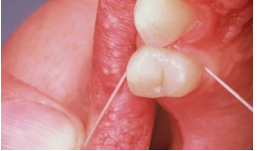


Floss is able to reach into narrow spaces between the teeth where use of an interdental brush may be very difficult and will also remove plaque where two teeth have contact. 


Flossing is certainly technique sensitive.  If floss is used too vigorously, gum tissue can be traumatized.  Typically, dental floss should be wrapped around the 2 middle fingers and stretched to a 12 to 18 inch length. Gently move back and forth in the area where the teeth contact each other, wrapping your floss it in a “C” shape around the side of the tooth. Once the floss is through this contact area it is gently moved under the tissue just until resistance is met. It is important not to “jam” the floss under the tissue, as this pulls on the periodontal ligament and can cause damage to the tissue and result in very sore gum tissue. At this point a cleaning stroke moves the floss away from the gum tissue toward the contact spot. Continue with this 6-8 times until a squeak can be heard and the tooth surface is clean. Then move the floss to the adjacent tooth and do the same. 

Possible limitations of floss:  Back teeth (molars and premolars) often have a more complex anatomy between teeth due to root concavities.  A root concavity is a linear developmental depression in the root surface. In health, root concavities are covered in alveolar bone and actually help secure the tooth in the bone.  Flossing may not access these difficult to clean and plaque retentive areas. So for many periodontal patients, flossing as well as the use of an interproximal brush is necessary.


                                                 (anatomy (with root concavity) of a premolar)

                                                             INTERDENTAL BRUSHES


Interdental brushes (proxabrushes), floss and mechanical devices, are available to remove plaque between the teeth. Clinical studies have shown that manual interdental brushes are particularly effective at reducing plaque and gingivitis. Selecting the sizes and types of interdental cleaning devices that are best for you should include an assessment of the space between your teeth, contact points, areas that retain food, gum shape and position, and periodontal pocketing. 

Interdental brushes, or proxabrushes come in wider or thinner sizes Go-Betweens® (Sunstar Butler), to accommodate the various dimensions of the interdental spaces.  Interdental brushes are available with both coated and uncoated wire, and some include antibacterial agents (chlorhexidine) on the bristles. There are also ultrathin, rubbery versions of interdental brushes called Softpicks and Advanced Softpicks® (Sunstar Butler). Our patients who have dexterity issues often find interdental brushes or Softpicks easier to use than floss.  

There are also mechanical (or vibrating interdental brushes), but they do not seem to be as effective as floss or the manual interdental brushes.  A study of a mechanical interdental device (Interclean) in a German population revealed more plaque than with manual interdental brushes. 5 percent of interdental plaque remained following patient use of manual interdental brushes in this study.   In other studies, the same device was compared to the use of dental floss, and the device and manual dental floss were found to be equally effective in reducing plaque. Based upon the results of these clinical studies, manual interdental brushes are superior and floss is equally effective in reducing plaque.


The article by the AP about flossing has brought dentistry and oral hygiene, particularly flossing, into the news and into people's minds.  For that, we are thankful. Even people who admittedly do not floss, are coming to flossing's defense.  And it certainly opens up some open, some lighthearted and some not-so lighthearted discussion on the topic (many dental hygienists, assistants and dental practicioners are NOT happy with this article or the confusion it could cause!)

Ultimately, the goal of oral good hygiene and good dental care is to prevent, arrest, and control periodontal disease and caries. One's ability to remove plaque from all areas, including interproximal areas, is an essential part of every patient’s selfcare program. Your dentist, dental hygienist, and periodontist can work with you as to which oral hygiene aids are going to improve your oral health by examining the effectiveness of your daily plaque removal routine (measuring your plaque levels and the condition of your gum tissues), as well as selecting and demonstrating the best oral hygiene aids for your lifestyle, ability, health, tooth anatomy, your risk for cavities and your periodontal condition.

Britten Periodontics & Implant Dentistry is a periodontal practice offering patients personalized dental care in implant dentistry in Clearwater, Florida. Dr. Todd Britten received his Bachelor of Science & Doctorate of Dental Surgery from University of Florida, a Master’s Degree and Certificate in Periodontology and Implant Dentistry; and completed extensive training at the Institute of Advanced Laser Dentistry. He is one of the only board-certified periodontists in Pinellas County. He is a member of the American Academy of Periodontology, American Dental Association, Florida Association of Periodontists, Upper Pinellas County Dental Association, Hillsborough County Dental Association, Hillsborough County Dental Research Association and Florida West Coast Dental Association.

To learn more about Dr. Britten and his dental services visit our website at:http://www.clearwaterperiodontist.com or http://www.brittenperio.com or call (727) 586-2681.